🚀 DeepSWE: A Benchmark That Redefines How We Evaluate Coding Agents
Most coding benchmarks today make top AI models look surprisingly close in performance. But are they really that similar when working on real software projects? DeepSWE from Datacurve aims to answer that question.
🧠 What is DeepSWE?
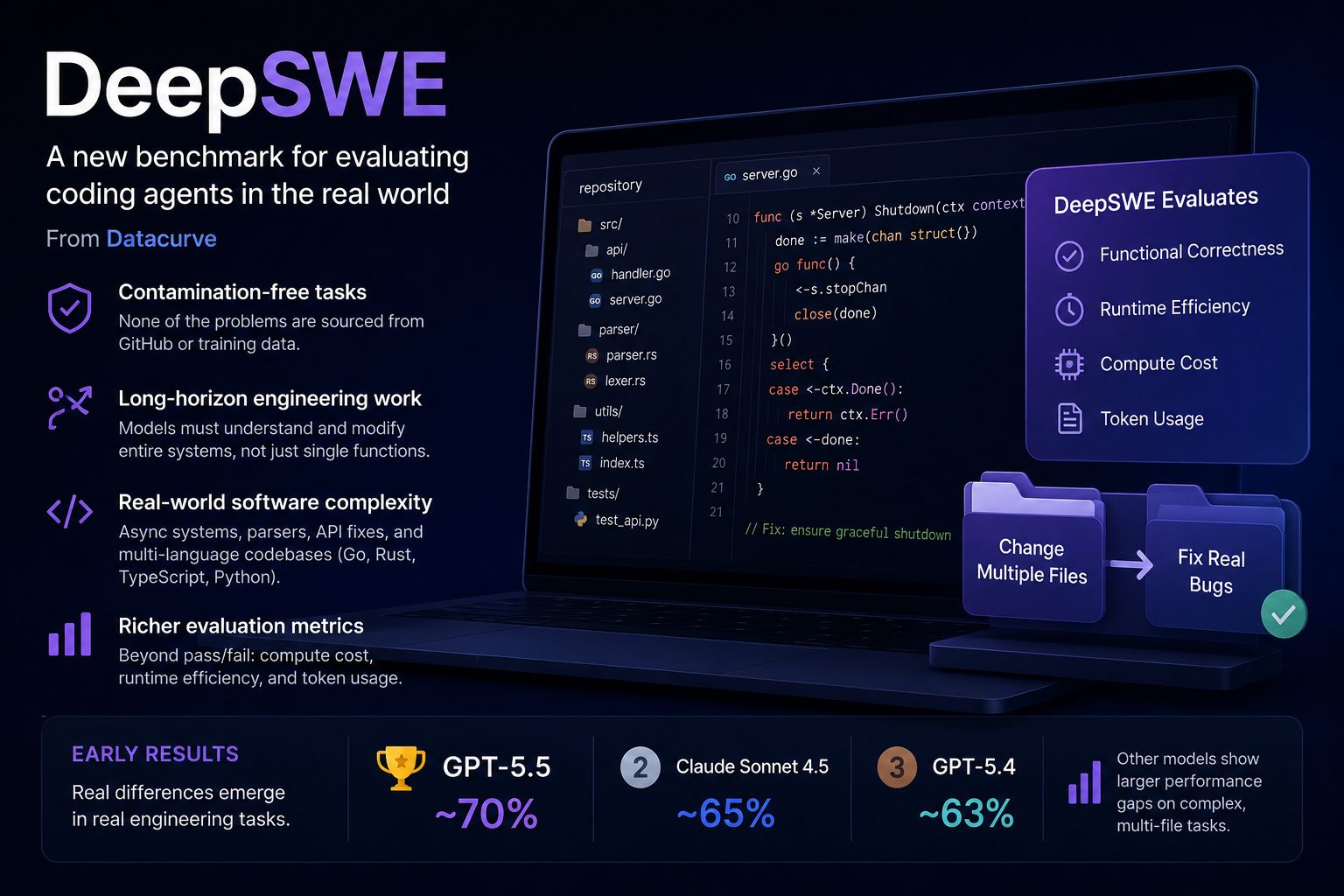
DeepSWE is a benchmark designed to evaluate AI coding agents in realistic software engineering environments. Instead of solving isolated coding challenges, models must:
- ✅ Work inside real repositories
- ✅ Modify multiple interconnected files
- ✅ Fix real-world bugs
- ✅ Ensure their changes don't break existing functionality
⚙️ What makes it different?
🔹 Contamination-free tasks The benchmark avoids problems that may have appeared in training data or public repositories.
🔹 Long-horizon engineering work Models need to understand and modify entire systems rather than individual functions.
🔹 Real-world complexity Tasks include:
- Async shutdown handling
- Parser and runtime fixes
- API behavior corrections
- Multi-language codebases (Go, Rust, TypeScript, and Python)
🔹 More meaningful evaluation Success isn't measured only by pass/fail rates. Runtime efficiency, compute cost, and token usage are also considered.
📊 Early results
- 🥇 GPT-5.5 (~70%)
- 🥈 Claude and GPT-5.4
- 📉 Several models show much larger performance gaps on complex multi-file engineering tasks than traditional benchmarks suggest.
The most interesting takeaway: real differences between models become much more visible when they are tested on realistic software engineering workflows rather than short coding exercises.
🔍 Why does this matter?
- 👉 Solving coding puzzles is not the same as doing software engineering.
- 👉 Existing benchmarks may underestimate meaningful differences between models.
- 👉 The future of AI evaluation is moving toward agent-based, real-world environments.
💡 Final thought
DeepSWE is more than another leaderboard. It's a reminder that if we want to measure AI's ability to function as a software engineer, we need to evaluate it in real engineering environments, not artificial coding puzzles.
Share Your Thoughts
If you'd like to share your opinion or start a discussion about this article, feel free to leave a comment on the LinkedIn post.