🎭 Roles aren't the magic ingredient
I think one of the biggest misconceptions in prompt engineering is that better roles automatically lead to better results. You've probably seen prompts like:
- "Act as a Senior Software Architect."
- "Act as a Principal Engineer."
- "Act as a Staff Software Developer with 15 years of experience."
And yes, role prompting can help. But after spending a lot of time working with AI tools, I've found that many people focus on the wrong part of the prompt.
A quick comparison
Consider these examples:
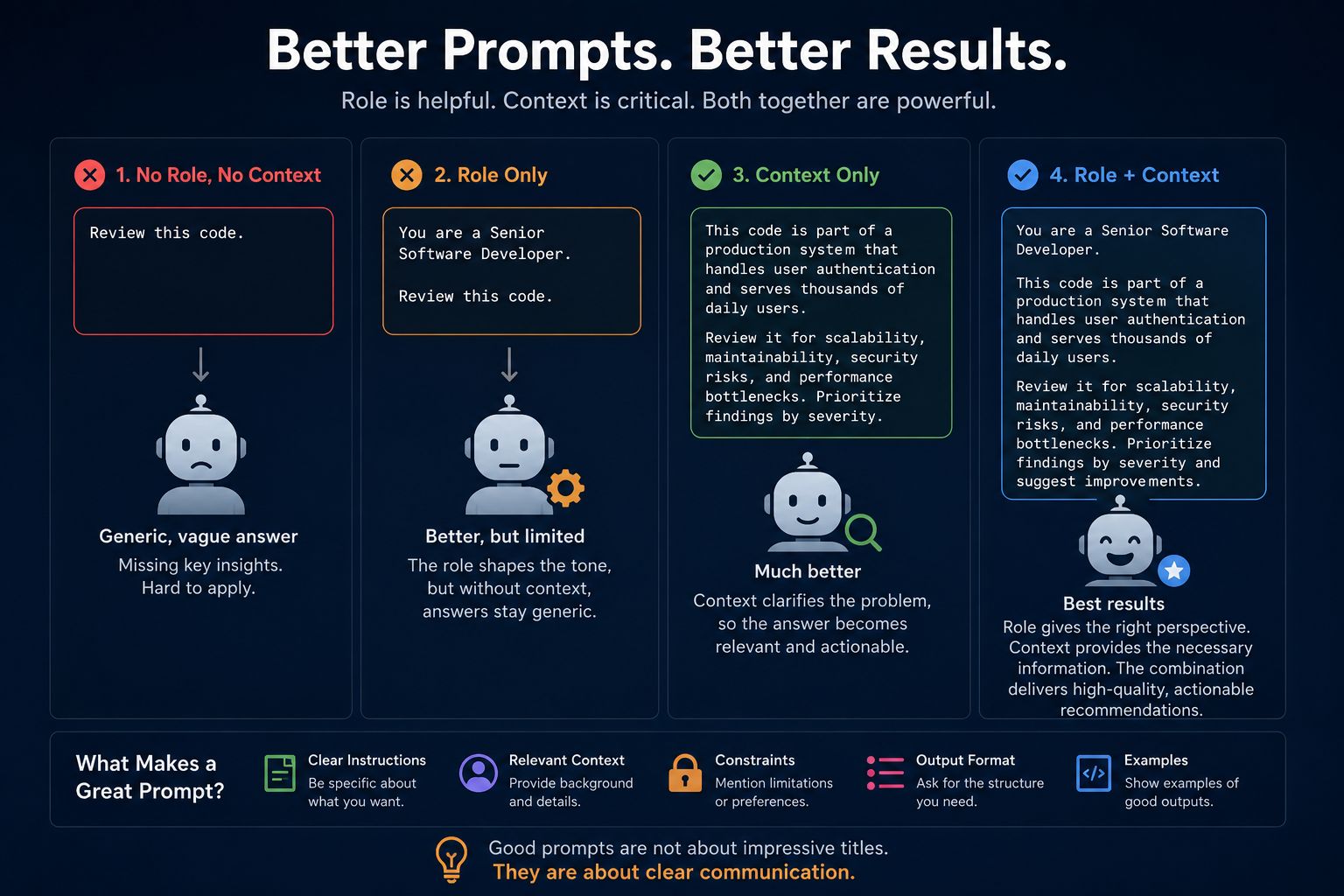
- ❌ Review this code.
- ❌ You are a Senior Software Developer. Review this code.
- ✅ This code is part of a production system that handles user authentication and serves thousands of daily users. Review it for scalability, maintainability, security risks, and performance bottlenecks. Prioritize findings by severity.
- ✅✅ You are a Senior Software Developer. This code is part of a production system that handles user authentication and serves thousands of daily users. Review it for scalability, maintainability, security risks, and performance bottlenecks. Prioritize findings by severity and suggest improvements.
Most people compare Prompt #1 and Prompt #2. The more interesting comparison is Prompt #2 and Prompt #4. The role didn't change. The quality improvement comes from adding context, objectives, constraints, and a clear output expectation.
Prompt engineering vs context engineering
That's why I think we've spent too much time discussing prompt engineering and not enough time discussing context engineering.
A role helps the model choose a perspective. Context helps the model understand the problem. And when you combine both, you usually get the best results.
This is also reflected in the prompting guidance published by OpenAI and Anthropic, which consistently emphasizes clear instructions, relevant context, constraints, examples, and desired output formats.
The question I ask now
So instead of asking:
"What role should I give the model?"
I've started asking:
"What information is the model missing to solve this problem well?"
That simple shift has improved my results more than any fancy persona ever did.
What has made the biggest difference in your prompts? Better roles, better context, examples, or structured outputs?
Share Your Thoughts
If you'd like to share your opinion or start a discussion about this article, feel free to leave a comment on the LinkedIn post.